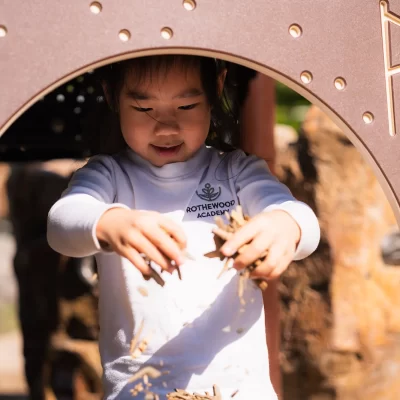
Natural play is part of everyday learning at Rothewood Academy because young children understand the world best when they can move through it directly. Our outdoor spaces are designed to encourage exploration using natural materials such as logs, sand, water, mud, stones, trees, hills, and plants. These spaces invite children to build, climb, dig, balance, collect, imagine, and experiment in ways that feel open-ended and meaningful to them.
Natural play is different from highly structured playground activity because the environment itself becomes part of the child’s thinking process. A stick can become a fishing rod, a magic wand, a bridge support, or a tool for drawing in mud. A pile of stones can turn into a bakery, a road, or a counting game. Children lead the play themselves, which strengthens creativity and independence because there is no single correct way to use the materials around them.
 For toddlers especially, this type of play supports early cognitive development in a powerful way. Young children are constantly building connections between movement, sensation, language, and understanding. When toddlers scoop sand, pour water, carry sticks, or climb uneven surfaces, they are learning through direct physical experience. They begin testing ideas about weight, texture, balance, speed, and cause and effect. Outdoor environments naturally encourage problem-solving because children must adapt to changing surfaces, shifting materials, and unpredictable outcomes.
Natural play also strengthens focus and emotional regulation. Research continues to show that regular exposure to nature supports healthy brain development, including the areas connected to attention, planning, and emotional control. Outdoor play offers toddlers space to move freely and release energy in healthy ways, which can help reduce stress and frustration. Natural environments often feel calmer and less overstimulating than brightly coloured indoor settings filled with constant noise and direction.
Our team has seen firsthand how this kind of play supports confidence. Climbing over logs, walking along uneven paths, balancing on rocks, or figuring out how to carry water from one place to another gives toddlers manageable challenges they can work through independently. Small moments of success build resilience because children learn that they are capable of trying difficult things, adjusting their approach, and trying again. These experiences help toddlers develop trust in their own bodies and abilities.
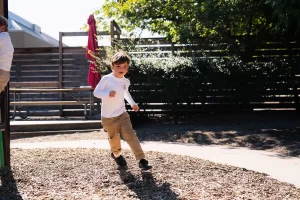 The physical benefits are equally important. Natural environments encourage whole-body movement in ways that traditional playground equipment often cannot. Toddlers squat, crawl, stretch, dig, lift, pull, and climb throughout their outdoor play. These repeated movements strengthen coordination, balance, hand-eye coordination, and fine motor control. Carrying buckets of sand, picking up pebbles, or gathering leaves all support muscle development while still feeling playful and enjoyable to children.
The social benefits are also extremely developmentally important. Because materials are open-ended, children are more likely to work together, negotiate, and collaborate when they engage in natural play. One child may begin building a structure while another gathers sticks or mud to add to it. Toddlers practice sharing ideas, observing peers, and communicating through action and language. Cooperative play develops naturally when children are working toward a shared goal they created themselves.
Natural play also connects children to the environment around them. Regular outdoor exploration helps toddlers notice seasonal changes, weather patterns, textures, sounds, and living things. They begin to recognize the smell of wet soil after rain, the crunch of leaves underfoot, or the feeling of cold water running through their fingers. These sensory experiences help children feel connected to the natural world in lasting ways.
We believe children need opportunities to experience nature not as something separate from learning, but as part of learning itself. Natural play supports intellectual, physical, emotional, and social development all at once because young children learn best through direct experience. Research continues to show that daily contact with nature positively impacts children’s well-being, focus, creativity, and overall health.
Most importantly, natural play gives toddlers time to wonder. It gives them opportunities to slow down, observe closely, invent games, solve problems, and follow their curiosity. These early experiences build the foundation for lifelong learning because children who feel confident exploring the world often grow into children who feel confident asking questions about it.
If you would like to see our schools, contact one of our Rothewood Academy schools to schedule an in-person tour.