In the Rothewood art studio, children meet the world through materials first, because paint, paper, and clay let them test ideas with their hands at the exact pace their minds are moving. The studio treats art as a way of thinking, because young children often understand more than they can explain, and making gives them a dependable route for showing what they notice. When a child is still building vocabulary, a brushstroke, a pressed thumbprint, or a carefully placed scrap can carry meaning without requiring a full sentence. This matters in early childhood, because children are constantly forming theories about relationships, patterns, and feelings, and they need formats that can hold complexity while language is still arriving.
Painting is often where that exploration begins. When Scholars choose colours, mix shades, add water, or press harder with a brush, they are learning through direct experience. They see what happens when red meets blue. They notice how thick paint moves differently from thin paint. They discover that a fast line feels different from a slow one. Each decision teaches them something about cause and effect while also strengthening their hands and wrists. Those small muscles matter, because controlled movements are needed later for writing, cutting, and detailed work across the classroom.
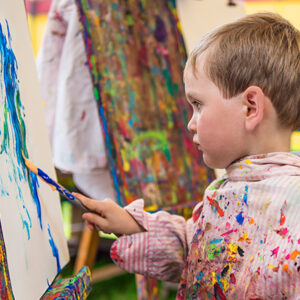
Painting also gives children space to express feelings in ways that feel safe and manageable. A page filled with bold colour can reflect energy or excitement. Light, careful
marks can show focus or ca
lm. Children can add to their work, change it, or cover parts they no longer want. That freedom builds flexibility. When a child adjusts a painting, they are practicing how to adjust a plan. They are learning that ideas can grow and shift over time.
Clay introduces a different experience. Working in three dimensions helps children think about form, balance, and structure. They squeeze, roll, pinch, and smooth, building strength in their hands while shaping their ideas into objects they can hold. Clay responds directly to pressure and movement, which helps children see the results of their effort right away. If something collapses, they rebuild it. If it cracks, they try again. This process teaches patience and persistence in a very concrete way.
Clay often holds stories. A child may create an animal, a house, a vehicle, or an imaginary creature. These forms reflect what they are curious about or trying to understand. Holding an idea in their hands makes it feel real and manageable. Clay also supports focus, because sculpting often unfolds over several steps. Children return to details, add texture, and refine shapes, extending their attention naturally.
Collage brings another layer of learning. When children cut, tear, arrange, and glue materials, they are making thoughtful decisions about space, colour, and texture. They learn how pieces fit together and how a small change can shift the whole picture. Collage strengthens fine motor control through repeated grasping and placing. It also builds spatial awareness, because children consider where each piece belongs and how much room to leave around it.
Collage can be especially powerful for children who are still developing language. A photograph, a scrap of fabric, or a leaf can represent a memory or an idea. Layering materials can show connection, movement, or change. Children pause to test arrangements before gluing, and that pause builds decision-making skills. They learn to trust their judgment about what feels complete.
Across painting, clay, and collage, children communicate through choices. Every colour selected, every shape formed, and every piece placed reflects attention and intention. Educators support this process by noticing and describing what children are doing. Simple observations about colour, shape, and movement help children connect their actions to words. When children want to talk about their work, the artwork gives them a clear starting point. When they prefer to stay quiet, the work still carries their thinking.
Using different mediums matters because each one offers a new way to explore ideas. Paint supports flow and movement. Clay supports structure and form. Collage supports selection and arrangement. Moving between them builds flexibility in thinking. Children learn that there are many ways to explore a question and many ways to show understanding.
Over time, the studio becomes a place where physical skill, emotional expression, and thoughtful learning grow together. The same hands that learn to hold scissors steadily also learn to shape an idea with care. The art studio allows children to show what they know before they can fully explain it. It supports independence because children make real decisions and solve real problems. It supports connection because shared creative work invites conversation and curiosity about one another’s ideas.
The result is a learning space where fine motor development, emotional expression, and cognitive growth reinforce one another, because the same hands that learn to cut along a line also learn to hold an idea steady long enough to share it. The studio becomes a place where children can show what they know before they can fully explain it, and that visibility helps educators respond to the child’s real thinking. Art supports independence, because children make decisions that matter, solve problems that arise naturally, and experience ownership over outcomes they can see and touch. Art also supports belonging, because shared making creates shared language, and children learn to recognize one another’s approaches, interests, and stories.
If you would like to see our studios, contact one of our Rothewood Academy schools to schedule an in-person tour.